
NAD+: The Science, the Hype, and What You Should Actually Know

If you’ve been searching for NAD+ therapy, chances are you’ve already seen some pretty big claims about what NAD+ can do. From energy and brain fog to recovery and healthy aging, NAD+ is everywhere in the wellness conversation right now, and it can be hard to tell where the science ends and the hype begins.
The important part is that NAD+ itself is not new. Your body already makes it, your cells depend on it, and researchers have been studying its role in cellular metabolism for decades.
What is newer is the growing interest in supporting NAD+ levels through IV infusions, injections, supplements, and other delivery methods.
At Injx Bar, we’re much more interested in helping you understand what NAD+ therapy is, how it works, why it matters, and where the research stands so you can decide whether exploring it makes sense for you.
What Is NAD+?

NAD+ stands for nicotinamide adenine dinucleotide. It’s a coenzyme found throughout your body that’s involved in hundreds of cellular reactions.
One of its biggest jobs? Helping your cells turn the food you eat into usable energy.
But NAD+ does more than that. It also plays a role in DNA repair, cellular stress responses, mitochondrial function, and normal cellular maintenance.
That distinction is important because NAD+ isn’t a stimulant and it doesn’t simply “give you energy.” Instead, it helps support the cellular machinery your body already uses to produce and manage energy in the first place.
NAD+ levels also change as we age and can be influenced by factors like metabolic health, inflammation, oxidative stress, sleep, nutrition, and other physiologic stressors. This relationship is part of the reason NAD+ has become such a big topic in longevity and performance medicine.
How Does NAD+ Work?
To understand why NAD+ matters, it helps to look at what is happening inside the cell.
Your mitochondria take nutrients from carbohydrates, fats, and proteins and help convert them into ATP, the usable form of energy that powers cellular activity. NAD+ is a critical part of that process because it helps shuttle electrons through the metabolic pathways responsible for producing ATP.
Think of it this way: food provides the raw fuel, your mitochondria are the power plants, and NAD+ helps move that fuel through the machinery so it can actually be converted into usable energy.
But energy production is only part of the story.
NAD+ is also used by important families of enzymes, including sirtuins and PARPs, that are involved in DNA repair, cellular stress responses, gene regulation, metabolism, and cellular maintenance.
In other words, NAD+ isn’t the fuel itself. It’s more like one of the resources your cells need to keep doing their jobs.
And because it’s involved in so many fundamental processes, researchers are paying close attention to what happens when NAD+ availability changes, particularly when it comes to mitochondrial function, metabolism, recovery, and healthy aging.
What Are the Potential Benefits of NAD+?
This is where we want to be careful.
NAD+ has very real, well-established functions in the human body. Research into what happens when we supplement or administer NAD+, however, is still developing, and the evidence isn’t equally strong for every proposed benefit.
With that in mind, here are some of the areas getting the most attention:
Cellular Energy and Fatigue - Because NAD+ is directly involved in mitochondrial energy metabolism, low energy is one of the most common reasons people become interested in NAD+ therapy. Some patients report feeling more energized with NAD+ protocols, but individual responses vary.
Mental Clarity and Cognitive Performance - Your brain requires a lot of energy, so mitochondrial function is especially relevant when researchers look at cognition and brain health. NAD+ and its precursors are currently being studied for their potential roles in cognitive health and neurodegenerative conditions, as well as whether compounds such as nicotinamide riboside could have a role in protecting against cognitive impairment. That research is interesting, but it’s still evolving. NAD+ shouldn’t be treated as a proven fix for brain fog or cognitive decline.
Exercise and Recovery Support - Athletes and active adults are another group increasingly interested in NAD+. Its role in cellular metabolism makes it a logical area of research for performance and recovery, but NAD+ isn’t a shortcut around the fundamentals. Sleep, nutrition, hydration, recovery time, and smart training still matter.
Metabolic and Mitochondrial Health - NAD+ is closely connected with glucose metabolism, fatty-acid metabolism, mitochondrial function, and cellular signaling. Those connections have made NAD+ metabolism an important area of research in metabolic health, particularly as scientists learn more about how cellular metabolism changes throughout the aging process.
Healthy Aging and Cellular Maintenance - This is probably where NAD+ gets the most attention. NAD+ plays a role in DNA repair and enzymes involved in cellular stress responses and maintenance. Researchers continue to investigate whether supporting NAD+ metabolism could meaningfully affect aspects of age-related cellular decline.
Overall, the most important thing to keep in mind is this:
NAD+ has well-established biological functions. That does not mean every proposed benefit of NAD+ therapy has been clinically proven.
We think patients deserve to understand both sides of that statement.
IV, Injectable, Oral, or Nasal? Understanding NAD+ Delivery

Once you start looking into NAD+ therapy, you’ll quickly realize that not every NAD+ protocol is the same.
Route of administration changes how the compound enters the body, how convenient the treatment is, and how much clinical data we have to guide its use. IVs, injections, oral precursors, and intranasal options all deliver or support NAD+ differently.
There is no universally established clinical hierarchy showing that one route produces superior long-term outcomes. However, the routes differ meaningfully in delivery, absorption, clinical oversight, convenience, and available evidence. Here’s how they compare:
1. IV NAD+
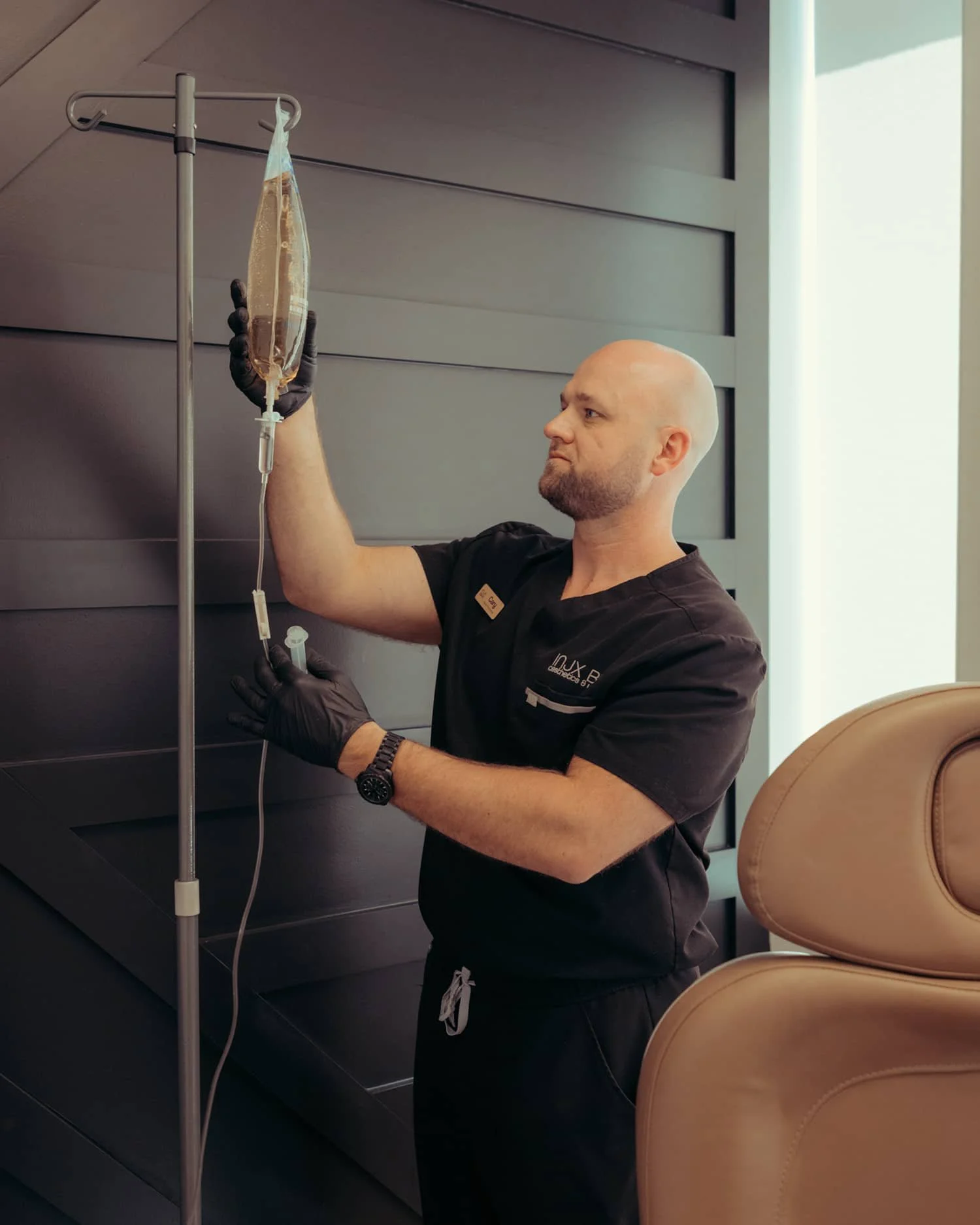
IV administration provides the most direct delivery into the bloodstream.
Because it bypasses the gastrointestinal tract, an IV allows NAD+ to be administered in a controlled setting under clinical supervision. The infusion rate matters, too. NAD+ is typically given slowly because administering it too quickly can cause temporary symptoms such as nausea, flushing, chest or abdominal pressure, headache, or general discomfort.
The tradeoff is time. An NAD+ IV requires IV placement and a longer appointment, typically one to four hours depending on the dose and individual tolerance, making it better suited for patients who prefer a supervised, more intensive treatment rather than frequent at-home administration.
2. Subcutaneous NAD+ Injections
Subcutaneous injections offer a practical middle ground between direct administration and convenience.
A small amount of NAD+ is injected into the fatty tissue beneath the skin and absorbed over time. For appropriate patients, this may make it possible to use smaller doses more consistently without sitting through a longer IV infusion.
That convenience can make injections appealing for someone interested in an ongoing protocol rather than occasional IV sessions.
That said, research directly comparing injectable NAD+ with IV therapy is limited. So, we don’t think of injections as simply a mini NAD+ IV. They’re different delivery methods with different practical advantages.
3. Intramuscular NAD+
NAD+ may also be given intramuscularly, meaning it’s injected into muscle tissue rather than the fatty tissue beneath the skin.
This is another way to bypass digestion, but that doesn’t automatically make it more effective than subcutaneous administration. It may also be less comfortable for some patients.
As with the other options, the right route depends on the formulation, dose, treatment goals, and the individual patient.
4. Oral NAD+ and NAD+ Precursors
Here’s where things get a little different.
Simply swallowing NAD+ isn’t necessarily the most effective way to increase NAD+ availability because much of it can be broken down in the gastrointestinal tract before reaching circulation intact.
That’s why many oral approaches use NAD+ precursors instead. Think of these as raw materials your body can use to make NAD+.
Two of the most commonly discussed are nicotinamide riboside (NR) and nicotinamide mononucleotide (NMN). Oral NADH, the reduced form of NAD+, is another option, although researchers are still studying its absorption and metabolism.
The obvious advantage here is convenience. Human research has shown that nicotinamide riboside can increase blood NAD+ levels, and studies have also evaluated the safety and metabolism of longer-term NR supplementation.
For some patients, an oral precursor may be a reasonable, low-maintenance option, particularly if the goal is to support the body’s natural NAD+ production or maintain levels between more direct treatments.
For others, provider-directed subcutaneous, intramuscular, or IV NAD+ may be a better fit.
5. Intranasal NAD+
Intranasal NAD+ is another option available at Injx Bar, using formulations prepared by reputable 503A compounding pharmacies.
Instead of going through the digestive system, NAD+ is delivered through the nasal mucosa, avoiding some of the breakdown associated with oral administration.
It sounds promising, but this is another area where we think it’s important to keep expectations grounded. Research specifically evaluating intranasal NAD+ in humans remains limited, and there are still many open questions about how best to target NAD+ metabolism therapeutically.
For now, we view intranasal NAD+ as an emerging delivery option rather than assuming it’s superior based on claims about absorption or brain delivery.
The takeaway? The “best” NAD+ route isn’t automatically the newest, strongest, or most aggressive one. It’s the one that makes sense for your goals, health history, tolerance, budget, and ability to stay consistent.
Who Might Be a Good Candidate for NAD+?
There really isn’t one type of “NAD+ patient.”
Some people start looking into NAD+ because they’re dealing with persistent fatigue, brain fog, or trouble bouncing back from demanding schedules. Others feel good overall and are simply interested in supporting performance, recovery, metabolic health, or healthy aging.
People who commonly ask us about NAD+ include:
Busy professionals juggling sustained physical and mental demands
Active adults and athletes interested in recovery and performance support
Patients experiencing fatigue or brain fog after more common underlying causes have been considered
Frequent travelers and people with demanding or inconsistent schedules
Patients interested in mitochondrial and metabolic health
Adults taking a proactive approach to healthy aging and longevity
But this is also where an actual evaluation matters.
Feeling tired doesn’t automatically mean you need NAD+. Brain fog doesn’t automatically point to a mitochondrial problem.
Poor sleep, inadequate nutrition, dehydration, anemia, thyroid dysfunction, hormone changes, medication effects, nutrient deficiencies, metabolic conditions, and plenty of other issues can leave you feeling exactly the same way.
Sometimes NAD+ makes sense as part of the plan. Sometimes there’s something more important we need to address first.
Why Explore NAD+ Therapy at Injx Bar?

At Injx Bar, we are interested in optimization, but not at the expense of basic clinical reasoning.
NAD+ can be an interesting tool for patients focused on energy, recovery, performance, and healthy aging. But that doesn’t mean everyone needs the same dose, the same delivery method, or NAD+ at all.
We start with the patient.
That means looking at your symptoms, health history, medications, labs when appropriate, lifestyle, and what you are actually trying to accomplish. From there, we can discuss whether NAD+ makes sense and whether an IV, injections, an oral precursor, or another approach better fits your goals.
We also keep expectations realistic.
NAD+ has an important and well-established role in human biology, and the science surrounding NAD+ optimization is exciting. But many of the clinical benefits being explored are still emerging, and wellness marketing can sometimes move faster than the science.
We think patients should understand the difference between what NAD+ is known to do biologically, what the research suggests it may do clinically, and what has yet to be proven before deciding whether it is worth their time and money.
Ready to Learn More?
If you’ve been curious about NAD+ therapy for energy, recovery, cognitive performance, or healthy aging, schedule a consultation with us at Injx Bar Aesthetics & Wellness in Peoria, AZ.
We’ll talk through what you’re experiencing, what you’d like to improve, and whether NAD+ actually deserves a place in your wellness plan.
LIKE THIS POST? SHARE IT TO PINTEREST!

The information above is provided for educational purposes only and should not be interpreted as medical advice. NAD+ protocols and routes of administration should be considered on an individual basis with a qualified healthcare provider. Certain formulations and uses may involve compounded medications that have not been reviewed or approved by the FDA for the diagnosis, treatment, cure, or prevention of a specific condition.